In the late 1980s, Japanese motorcycle engineering reached a peak of technical arrogance the world may never see again. With budgets seemingly unlimited thanks to Japan’s “Bubble Economy,” the goal wasn’t just to build a better motorcycle—it was to prove which manufacturer had the most brilliant engineers. And in this race for supremacy, Honda embarked on a project that everyone else thought was mechanically impossible.
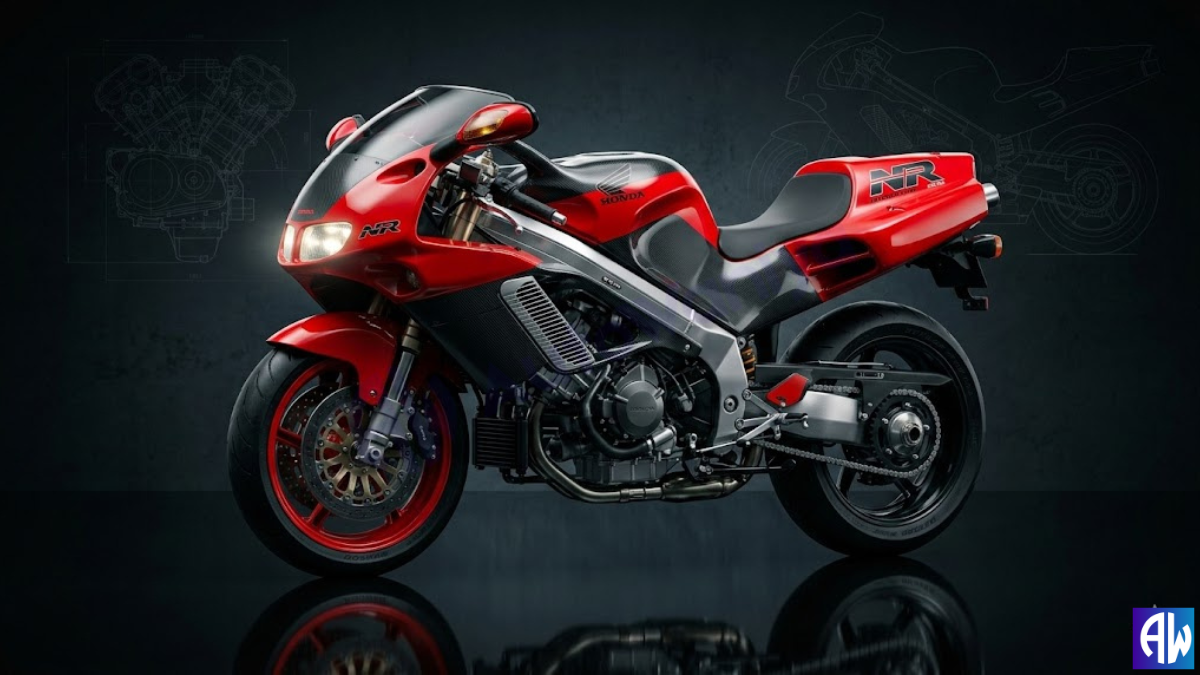
The result, which finally reached customers in 1992, was the Honda NR750. A motorcycle so complex, so expensive, and so advanced that it remains a technical dead end, a beautiful anomaly, and today, the most coveted Japanese motorcycle in the collector world. This is the story of the bike that was simply too far ahead of its time.
The “Never Ready” Project: A Racing Obsession
The NR750’s origins lie not on the street, but on the racetrack. When Honda returned to Grand Prix racing in 1979, the grid was dominated by lightweight, powerful two-stroke machines. Instead of following the herd, Honda’s engineers were determined to win with four-stroke technology. The rules limited them to four cylinders, so to make a four-stroke competitive, they needed to make it breathe like an eight-cylinder.
Their solution? Oval pistons.
By shaping the pistons like an elongated oval, they could fit eight valves and two spark plugs into a single cylinder head—effectively giving a four-cylinder engine the valve area of a V8. The racing project was plagued with problems. Sealing oval piston rings and managing the heat was a nightmare, leading to constant failures. The racing press mockingly dubbed it “Never Ready.”
But Honda’s engineers refused to give up. They spent over a decade refining the metallurgy and precision machining, and by the early 1990s, they had succeeded in creating a street-legal version of their racing dream.
The 1992 Honda NR750: A Rolling Engineering Manifesto
When the NR750 finally debuted, it was unlike anything the world had ever seen. And it came with a price tag to match: a staggering $50,000—more than a contemporary Ferrari. Honda produced only around 300 units (some estimates suggest only 200 actually reached customers).
| Engine | Power | Torque | 0-60 mph | Top Speed |
|---|---|---|---|---|
| 747cc V4 (Oval Piston) | 125 hp | 49 lb-ft | 3.8 Seconds | 160 mph |
The numbers might not seem mind-blowing by today’s standards, but the quality of the power and the engineering behind it were from another planet. The engine used eight titanium connecting rods (two per piston) and gear-driven camshafts to ensure perfect timing at its 14,000 RPM redline. The result was a linear, jet-like thrust that was eerily smooth, accompanied by a distinct mechanical whine from those gear-driven cams.
Aerospace Materials and Digital Innovation
Honda didn’t stop at the engine. The NR750 was a showcase for materials and technology unheard of on two wheels in the early ’90s.
- Carbon Fiber Bodywork: The fairings were constructed from advanced composites, keeping weight down and showcasing a premium, race-inspired aesthetic.
- Iridium-Coated Windshield: A feature borrowed from fighter jet canopies, designed to reduce glare for the rider.
- Floating Digital Speedometer: A futuristic display that projected the speed into the rider’s field of vision using mirrors, allowing for quick glances without refocusing.
- Single-Sided Swingarm and Under-Seat Exhaust: Design elements that would later become signature features on premium sportbikes from other manufacturers.
The Ultra-Rare French Anomaly: The NR750 RC41
If the standard NR750 (internal code RC40) is rare, the RC41 variant is a ghost. This version was created specifically for the French market to comply with local power restrictions that capped motorcycles at 100 hp.
| Model | Engine | Power | Torque | 0-60 mph | Top Speed |
|---|---|---|---|---|---|
| 1992 Honda NR750 (RC41) | 747cc V4 (Oval Piston) | 100 hp | 47 lb-ft | 4.2 Seconds | 150 mph |
Only about 20 units of the RC41 were ever produced. It featured revised camshafts and a remapped fuel injection system to meet the lower output. In the modern collector market, an RC41 is the ultimate unicorn. A pristine example was recently listed in the UK for £115,000, proving that lower power does nothing to diminish desirability when you’re talking about a bike this rare.
A Collector’s Holy Grail in 2026
Today, the NR750 has ascended to blue-chip status in the collector motorcycle world. Its rarity, combined with its unparalleled engineering story, makes it the most sought-after Japanese motorcycle ever produced.
Current market values, according to Hagerty and auction results, reflect its legendary status:
| Condition | Price Range (Hagerty Estimates) |
|---|---|
| Poor | $60,000 – $80,000 |
| Good | $80,000 – $110,000 |
| Excellent | $120,000 – $150,000 |
| Concours | $150,000 – $220,000 |
High-mileage examples have sold for around $69,600, but pristine, well-preserved bikes consistently command over $150,000 at top auctions like Iconic Motorbike Auctions.
The Final Verdict: A Monument to Mechanical Ambition
The Honda NR750 was never about profit. Honda lost money on every single unit sold. It was a statement. It was proof that Honda’s engineers could solve any problem, no matter how many oval pistons it required. It was a bike built to show the world the absolute pinnacle of what was mechanically possible.
In an era moving toward electrification, the NR750 stands as a permanent monument to mechanical complexity. It’s a time capsule from the peak of Japanese industrial power—a motorcycle that was, and remains, truly too advanced for its time. No other manufacturer has ever attempted a production oval-piston engine, and it’s a chapter in history that will likely never be reopened.
For the collector who can find one, owning an NR750 isn’t just owning a motorcycle. It’s owning a piece of engineering art, a racing legend, and the definitive proof that when you give brilliant engineers a blank check, they can create something that haunts the dreams of enthusiasts for decades.
The NR750 remains the ultimate what-if of motorcycling—a glorious, complex, and unforgettable masterpiece.