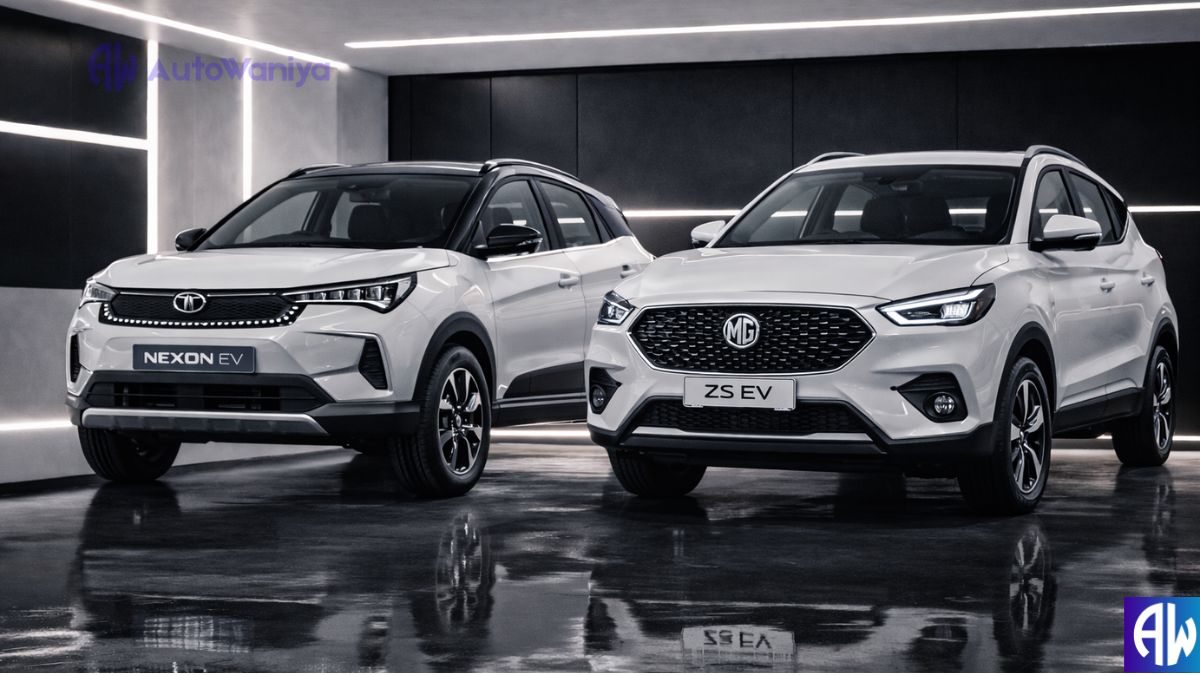
The Indian electric vehicle market has grown up. Gone are the days when buyers had to settle for a single, no-choice option. Today, the question isn’t “Should I buy an EV?” but rather, “Which EV is right for me?”
Two names dominate this conversation: the Tata Nexon EV and the MG ZS EV. Both are practical, modern, and backed by brands with deep roots in India. Yet, they cater to two very different kinds of buyers.
One is an agile, value-focused urban warrior. The other is a spacious, feature-loaded highway cruiser. Choosing between them isn’t about which is “better”—it’s about which is better for you.
Let’s break it down in a way that helps you see your own reflection in the right car.
Size and Road Presence: Compact Agility vs. Commanding Stance
The difference between these two SUVs is evident the moment you park them side-by-side.
Tata Nexon EV:
The Nexon EV is the nimble one. Its compact dimensions make it a natural ally in India’s chaotic city traffic. Slipping through narrow lanes, squeezing into tight parking spots, and making U-turns on crowded roads feels effortless. It has a sporty, youthful stance that looks right at home in a bustling metro .
MG ZS EV:
The ZS EV, in contrast, commands attention with its larger footprint. It has the broad shoulders and traditional proportions of a proper SUV. If you want a vehicle that announces its presence and offers a more commanding view of the road, the MG delivers that in spades. It feels substantial, planted, and premium .
The Choice: If your life revolves around dense city cores and tight parking, the Nexon’s agility wins. If you prioritize road presence and a bigger feel, the ZS EV is your answer.
Battery, Power, and Range: Flexibility vs. Refined Muscle
Under the skin, these two take very different approaches to electrification.
Tata Nexon EV:
Tata offers flexibility. The Nexon EV comes with multiple battery pack options, allowing you to choose what fits your budget and travel needs .
- 30 kWh Battery: Delivers a claimed range of 325 km, with 125 bhp and 215 Nm of torque. Perfect for daily commutes and city running .
- 45 kWh Battery (Long Range): Pushes the range to an impressive 489 km, with power climbing to 141 bhp. This is for those who want highway flexibility without constant charging stops .
The Nexon feels incredibly quick off the mark, especially in city traffic, thanks to the instant torque delivery of its electric motor .
MG ZS EV:
MG has kept it simple with a single, potent 50.3 kWh battery pack . It offers a claimed range of 461 km and produces significantly more power: 174 bhp and 280 Nm of torque .
This extra power makes the ZS EV a relaxed highway companion. It has the muscle to accelerate confidently at high speeds, making overtaking on expressways feel safe and effortless. In real-world conditions, you can expect a practical range of around 350 km .
The Choice: If you want the freedom to choose your range (and budget) and love a quick city feel, the Nexon’s flexibility is appealing. If you want a more powerful motor for relaxed, long-distance touring, the ZS EV is the stronger contender.
Charging Convenience: How They Fit Into Your Day
Both cars support standard home charging and DC fast charging, but the experience differs slightly.
The Nexon EV benefits from Tata’s rapidly expanding national charging ecosystem. Using a DC fast charger (50 kW), the 30 kWh battery can go from 10% to 80% in about 56 minutes . Home charging times vary based on the battery pack and the charger you install .
The MG ZS EV supports DC fast charging at up to 50 kW, achieving a 0-80% charge in approximately 60 minutes . Using a 7.4 kW AC home charger, a full charge takes about 9 hours—perfect for an overnight top-up .
The Verdict: Both integrate smoothly into daily life. The Nexon offers more battery choices to match your charging routine, while the ZS EV offers a consistent, proven charging curve.
Cabin Experience: Sporty Utility vs. Premium Lounge
Step inside, and the personality of each car becomes even clearer.
Tata Nexon EV Interior:
The Nexon’s cabin feels modern, youthful, and tech-forward. It features a floating touchscreen, a fully digital driver’s cluster, and connected car technology. The layout is user-friendly, designed to make new EV adopters feel comfortable immediately. Higher variants offer ventilated front seats, a 360-degree camera, and a voice-assisted sunroof . The boot space is practical at around 350 litres .
MG ZS EV Interior:
The MG cabin ups the ante on space and perceived luxury. The seats are broader, the materials feel richer, and the overall ambiance is more premium . Rear passengers are treated to significantly more legroom, making it a better choice for chauffeuring tall adults or elders.
The panoramic sunroof is a genuine highlight, flooding the cabin with light and making it feel airy . The boot is also cavernous at 488 litres, easily swallowing large suitcases for family trips .
The Choice: The Nexon is a feature-packed, sporty space. The ZS EV is a more spacious, luxurious lounge on wheels.
Safety: Two Champions, Different Strengths
Both manufacturers prioritize passenger protection, and both cars have stellar credentials.
The Tata Nexon EV is built on the legendary HEARTECT platform. It holds a 5-star Global NCAP rating for adult and child safety, a testament to its robust engineering . Depending on the variant, it packs 6 airbags, ESP, hill-hold assist, and a 360-degree camera .
The MG ZS EV takes safety a step further into the digital age. It also has a 5-star Euro NCAP rating . Crucially, higher variants come equipped with Level-2 ADAS (Advanced Driver Assistance Systems) . This includes features like adaptive cruise control, autonomous emergency braking, lane keep assist, and blind spot detection . These systems act as a co-pilot, adding an extra layer of protection on long, monotonous highway drives.
The Verdict: Both are exceptionally safe. The Nexon offers proven structural integrity. The ZS EV offers advanced electronic safety nets.
Price Positioning: Value vs. Premium
This is where the separation between the two becomes a decisive factor for most buyers.
The Tata Nexon EV is the more accessible, value-focused option. Prices start at around ₹12.49 Lakh (ex-showroom) and go up to approximately ₹17.49 Lakh for the top-end long-range variants . Furthermore, Tata is currently offering attractive discounts of up to ₹1.41 Lakh under a celebratory program, making the entry even sweeter .
The MG ZS EV is positioned as a premium product. Prices start at ₹17.99 Lakh (ex-showroom) and go up to ₹20.50 Lakh for the top-spec Essence variant .
The Choice: The Nexon EV is a smart, attainable value purchase. The ZS EV is a premium upgrade, a choice you make when you want the extra space, power, and luxury features.
Running Costs and Maintenance
No matter which you choose, the shift to electric brings the same fundamental advantages:
- Lower running costs: Electricity is significantly cheaper than petrol or diesel per kilometre.
- Simpler maintenance: Fewer moving parts mean fewer things to service or replace.
- Peace of mind: Both brands offer strong battery warranties (MG offers up to 8 years) .
Which One Should You Bring Home?
Still confused? Let’s make it simple.
Choose the Tata Nexon EV if:
- You want an affordable entry into electric mobility.
- Your driving is primarily in the city and you value nimble handling.
- You like the flexibility of choosing between different range and budget options.
- You want a proven, 5-star safe vehicle with a youthful, sporty feel.
Choose the MG ZS EV if:
- You want a larger, more spacious SUV with a premium interior.
- You frequently take long highway trips and value the extra power and range confidence.
- You want the latest tech, including a panoramic sunroof and Level-2 ADAS.
- You are willing to pay a premium for a bigger, more luxurious package.
Both vehicles represent how far electric mobility has come in India. One focuses on value and accessibility; the other leans into size and luxury. Neither choice is wrong. The right answer depends entirely on your priorities, your parking situation, and the stories you want your car to be a part of.
Disclaimer: Specifications, features, prices, range figures, and charging times mentioned in this article are indicative and based on information available as of February 2026. Actual details may vary by variant, city, and future updates from the manufacturers. Please verify the latest information, including on-road prices and applicable incentives, with your nearest authorized dealership before making a purchase decision.