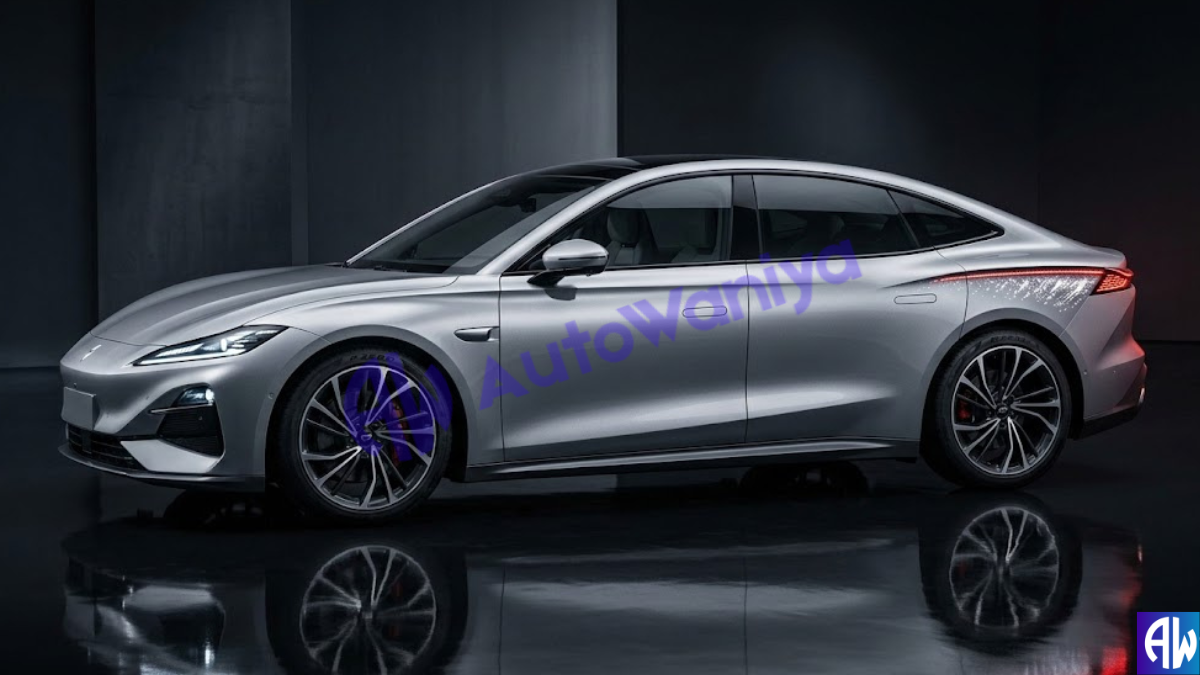
China’s automotive industry is moving at lightning speed, and its latest creation is turning heads for a very specific reason. Meet the SAIC Z7, a new all-electric sedan (and its wagon sibling, the Z7T) that, from almost every angle, bears a rather striking resemblance to the Porsche Taycan.
From the silhouette and body surfacing down to the tiny fender vents and rear diffuser, the inspiration is clear. But before you dismiss it as a simple copy, look closer. Underneath that familiar skin lies a very different philosophy, highlighted by a wildly innovative interior feature and a price tag that could be as little as a quarter of the Porsche’s.
Developed by HIMA—a joint venture between electronics giant Huawei and automaker SAIC (the company behind MG, LDV, and Maxus)—the Z7 is a fascinating blend of borrowed style and original tech. Let’s dive into what makes this new EV so intriguing.
Design: A Familiar Silhouette with Unique Details
There’s no getting around it: the SAIC Z7 and Z7T look remarkably like the Porsche Taycan and its Cross Turismo wagon variant. The sloping roofline, the muscular haunches, and the overall cab-rearward stance are unmistakably Taycan.
- The Shared Details: The inspiration extends to specific elements, including the small vertical air intakes at the edges of the front bumper, the tiny vent on the trailing edge of the front fender, and the diffuser cutout in the rear bumper.
- The Divergence: Where they differ is in the lighting. The headlight and tail-light designs are similar in shape but not identical. The Z7’s tail-lights feature a unique, intricate “sparkle effect” graphic that gives it its own distinct nighttime identity.
- Available Upgrades: The Z7 can be equipped with matrix LED headlights and even an illuminated badge, adding to its premium tech appeal.
The Interior Showstopper: A “4D” Floating Screen
While the exterior may channel Porsche, the interior is where the SAIC Z7 goes its own way—dramatically.
- Giant Freestanding Touchscreen: Instead of the Taycan’s integrated curved display setup, the Z7 features a massive, freestanding touchscreen that dominates the dashboard.
- It Moves: The party piece is that this screen can move electronically in “four dimensions” —meaning it can be tilted left, right, up, and down to suit the driver’s preference or reduce glare. It’s a level of adjustability rarely seen and adds a futuristic, almost theatrical element to the cabin.
- Other Cabin Features: A head-up display is also available, projecting key information onto the windscreen. A panoramic glass roof likely adds to the sense of space and airiness inside.
Technology and Performance
True to its Huawei connection, the Z7 is expected to be a technological showcase, especially in its driver assistance capabilities.
- LIDAR on Board: A roof-mounted LIDAR pod confirms the Z7 will feature advanced driver assistance systems, likely utilizing Huawei’s expertise in autonomous driving tech.
- Braking and Wheels: For stopping power, some versions will feature cross-drilled brakes with Brembo calipers. The models in the images ride on 20-inch alloy wheels shod with 275/40 Continental EcoContact 7S tyres.
- Expected Powertrains: While full specifications are yet to be announced (details are expected at the end of March), reports from My Drivers suggest two battery options:
- An 80kWh battery for rear-wheel drive variants.
- A larger 100kWh battery for all-wheel drive versions.
Pricing: The Taycan Alternative for a Fraction of the Cost
This is where the SAIC Z7 becomes a truly compelling proposition. In China, the fully imported Porsche Taycan carries a hefty price tag due to tariffs, ranging from ¥918,000 to ¥1.57 million (approximately A$190,000 to A$324,400).
The SAIC Z7, built locally, is expected to be priced between ¥220,000 and ¥310,000 (approx. A$45,500 to A$64,100). That puts it in a completely different bracket, directly targeting the Xiaomi SU7 and making it accessible to a much wider audience.
It’s also part of a broader trend. While it’s been a while since a Chinese manufacturer released a vehicle so closely resembling a foreign design (past examples include the Landwind X7 mimicking the Evoque, and the BYD F3 echoing the Corolla), the Z7 does so with a level of refinement and its own unique technological flair.
The Final Verdict: Inspired or Derivative?
The SAIC Z7 is undoubtedly a vehicle that will provoke strong opinions. Its design lineage is impossible to ignore. However, to label it a simple copy would be to overlook its own distinct identity.
It combines a proven, popular aesthetic with a genuinely innovative interior feature (the moving screen), advanced driver assistance tech (thanks to Huawei), and an aggressively competitive price point. For buyers who love the Taycan’s shape but not its six-figure price tag, the Z7 offers a fascinating, tech-forward alternative.
It remains to be seen how it drives and whether the final specifications can match its promise. But one thing is certain: the SAIC Z7 has successfully grabbed the world’s attention and added another layer of intrigue to the rapidly evolving Chinese EV market.
If you’re curious about the future of affordable electric style, the SAIC Z7 is a name you’ll want to remember.