Remember that wedge-shaped silhouette from the 1990s? The one with the massive glass area that made you feel like you were piloting a spaceship through Indian traffic? For a generation of Indians, the Tata Sierra wasn’t just a vehicle; it was a poster on the wall, a childhood dream, and a symbol of arriving in life.
After years of teasing concepts and fuelling speculation, Tata Motors is finally ready to bring the icon back. Slated for a 2026 launch, the new Sierra isn’t just another SUV in an overcrowded market. It is a piece of automotive nostalgia re-engineered for the electric age.
But here’s the million-rupee question: In a world dominated by Korean design flair and German precision, can this desi darling survive on emotion alone? We dug deep into the official reveals, spy shots, and industry chatter to bring you the full story of the Tata Sierra 2026.
From the 90s Zeitgeist to the Modern Age
To understand the hype around the 2026 Sierra, you have to understand its ancestor. Launched in 1991, the original Tata Sierra was India’s first sports utility vehicle aimed at the personal buyer. It was bold, unconventional, and unapologetically different. Based on the Tata Mobile platform, it featured a three-door layout with those iconic curved windows that wrapped around the rear.
It was a lifestyle vehicle before the term existed in the Indian lexicon. However, safety regulations and changing market dynamics eventually forced it into retirement. It became a memory, a “what if” story that Tata enthusiasts told at car meets.
Fast forward to 2020. Tata Motors stunned the world at the Auto Expo with the Sierra EV concept. It was a masterclass in retro-futurism. The design team, led by Pratap Bose at the time, managed to retain the soul of the original—the floating roof, the unique window line—while wrapping it in the brand’s new “Impact Design” language. The 2026 version you see in the latest patents and teasers is the production-ready evolution of that dream.
Breaking Down the 2026 Design: A Closer Look
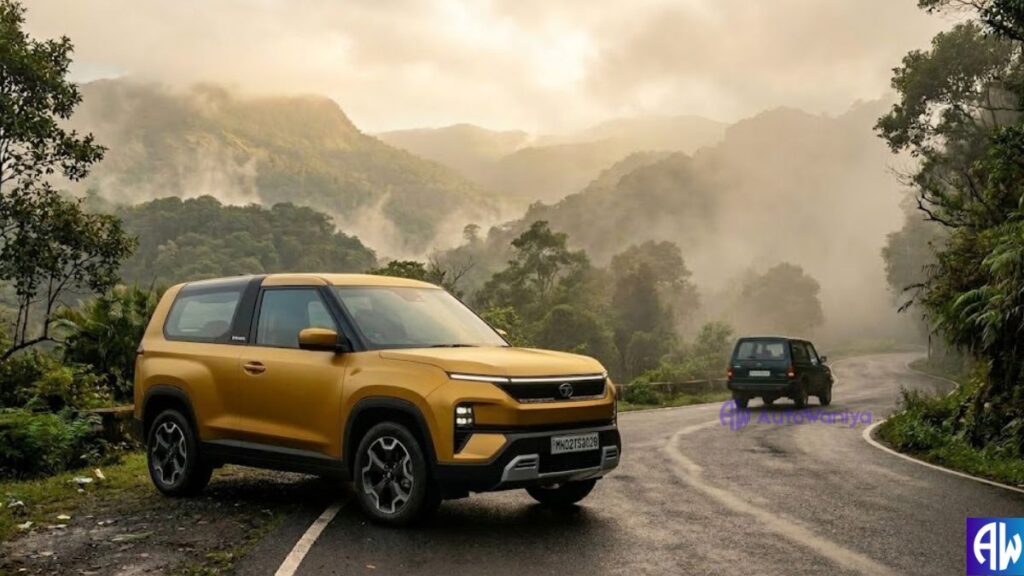
The production-spec Tata Sierra 2026 is a visual treat. It borrows heavily from the Curvv SUV coupe philosophy but stands on its own as a distinct identity. The front end is unmistakably Tata, featuring a sleek, full-width LED light bar that connects the sharply designed headlamps. The grille is closed off, a clear giveaway that this iteration is primarily being developed as an electric vehicle (EV).
Move to the side, and that’s where the magic happens. The silhouette is unmistakably Sierra. The steeply raked A-pillars and the floating roof create a coupe-like stance. Unlike the boxy standard SUVs, the Sierra has a sense of movement even when standing still.
The rear is a masterstroke. Designers have cleverly modernized the signature curved glass. While the original had a massive wraparound window, the 2026 model uses a glass panel that visually connects with the rear windscreen, giving a nod to the past while improving structural rigidity and safety.
The Electric Heart and the Practical Choice
While the design tugs at the heartstrings, the underpinnings appeal to the head. The 2026 Tata Sierra is expected to ride on the brand’s advanced architecture. This is the same born-electric platform that underpins the Punch EV and the upcoming Harrier EV.
This is a significant advantage. A dedicated EV platform means no compromises on interior space or battery packaging. You can expect a flat floor, more cabin room, and a battery pack neatly tucked under the floor for a low center of gravity.
What about range? Industry insiders suggest Tata is targeting a real-world range of over 400-450 kilometers on a full charge. This would put it in direct competition with the likes of the MG ZS EV and the upcoming Hyundai Creta EV. However, there is a twist. Given the popularity of internal combustion engines (ICE) in this segment, Tata might also offer a mild-hybrid or turbo-petrol version, though the primary focus remains electric.
A Cabin That Promises to Be a Lounge
Step inside, and the Sierra is expected to redefine “premium” for Tata. The Avinya concept gave us a glimpse of the brand’s future interior philosophy, and elements of that will trickle down to the Sierra. Expect sustainable materials, a minimalist dashboard dominated by large screens, and a two-spoke steering wheel.
The original Sierra was famous for its light and airy cabin thanks to all that glass. The 2026 version will double down on that. A massive panoramic sunroof (or maybe even a dual-pane setup) will ensure the cabin feels open and luxurious. Given the flat floor of the EV architecture, rear passengers will finally get the legroom and comfort that the old Sierra could never offer.
Nostalgia vs. Reality: Can It Win Over the New Buyer?
This is the tightrope Tata Motors has to walk. The enthusiasts who remember the original Sierra are now in their 40s and 50s. They have the money to buy one, but they are also more discerning. They care about brand value, after-sales service, and driving dynamics.
On the other hand, the Gen Z buyer might not know or care about the 90s icon. They just see a cool-looking coupe SUV. For them, the appeal lies in the tech, the connectivity, and the Instagram-worthy design.
Tata has to cater to both. The marketing campaign for the Sierra 2026 will likely be one of the most emotional yet technologically focused campaigns we’ve seen from an Indian automaker. It needs to tell the story of the past while showcasing the features of the future, like Level 2 ADAS (Advanced Driver-Assistance Systems), over-the-air updates, and a premium sound system.
The Market Battlefield
The year 2026 is shaping up to be a massive battleground for SUVs in India. By the time the Sierra launches, the market will be flooded with options.
- Hyundai Creta EV: The Korean giant is not going to give up its crown without a fight.
- Maruti Suzuki eVX: With Toyota’s backing, this will be a volume player.
- MG ZS EV Facelift: The British-origin brand already has a foothold.
- Volkswagen ID.4: If priced aggressively, this could be a dark horse.
Tata’s biggest advantage is its “home ground” feeling. The emotional connection Indian buyers have with the Sierra nameplate is unmatched. If Tata gets the pricing right—ideally starting around the ₹22 lakh (ex-showroom) mark for the electric version—it could very well become the new benchmark for desirability in the segment.
The Waiting Game and Final Verdict
The Tata Sierra 2026 is more than a product launch; it is a cultural moment for Indian automobiles. It signifies that we have moved beyond just building affordable cars to building aspirational ones. It proves that Indian design studios can hold their own on the world stage.
There are still question marks. Will the production version dilute the concept’s charm? Will the charging infrastructure be ready to support another high-range EV? Can Tata’s service network handle the complexities of a premium electric vehicle?
For now, we have to wait. But the glimpse we have gotten is promising. The new Sierra doesn’t look like a car that was designed by a committee; it looks like a car that was designed with passion.
It carries the weight of a legacy on its shoulders. And from what we can see, it looks strong enough to carry that weight into a new, electric dawn.
The Road Ahead
Bookings are expected to open in late 2025, with deliveries commencing in the first quarter of 2026. If you were one of those kids who pressed their nose against the glass of a Sierra in the 90s, 2026 might just be the year you finally get to take the keys home.